(PS: If you really want to see these maps
then left click for a larger image and then right click to "save as" for better
viewing)
(PS: If you really want to see these maps
then left click for a larger image and then right click to "save as" for better
viewing)BILL, JJ, CAROL and DEBRA’S
EXCELLENT ADVENTURES IN THE
HIGH SIERRA CAMPS
YOSEMITE NATIONAL PARK
2 -10 SEPT, 2007
(click the thumbnail images for a larger view)
In Feb 07 JJ and I received notice that we had won the lottery! Well, not THE lottery--rather it was a lottery run by Delaware North Company on behalf of Yosemite National Park. This lottery allows a few of us lucky ones to have our first (or second) choices for dates and locations to visit the High Sierra camps. (Actually, most people don’t use the lottery at all but just call for cancellations and take what is available later in the season.)
There are seven High Sierra Camps (HSC) including Tuolumne Meadows and White Wolf Lodges which are accessible from the Tioga Pass highway and five that are reached only by hiking or horseback.
Our lottery selection allowed one night in Tuolumne Meadows Lodge and then a clockwise circuit of the five “real” HSCs with two nights each at Vogelsang and Merced Lakes HSC and one night at the other three. The map below shows an outline of Yosemite National Park (in pinkish color) with the HSC loop in blue. The loop covers a small but not insignificant portion of the Park.
(PS: If you really want to see these maps
then left click for a larger image and then right click to "save as" for better
viewing)
The other map shows a more detailed view of the HSC loop. (This same map is on the paper napkins used at all the camps.)
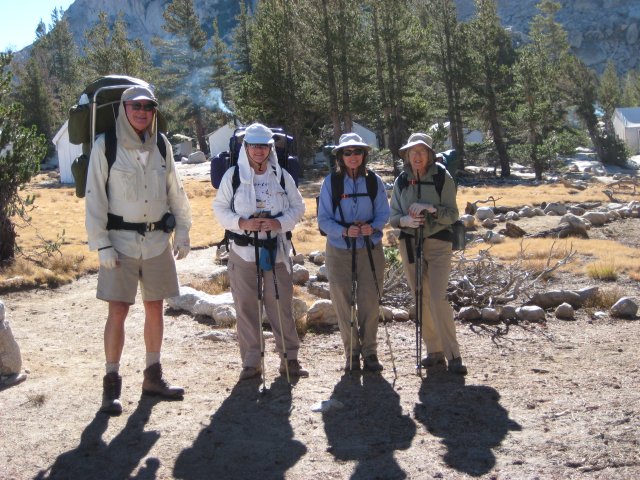
We were fortunate to complete the foursome for our self-guided loop with experienced hikers, Carol and Debra, via our mutual associations with the San Diego WalkAbout Groups.
September 1, 2007 Saturday
JJ and I drove from San Diego to Mammoth Lakes-a distance of 409 miles. Carol and Debra had already started their camping a few days earlier in the Mammoth area. Bill / JJ and Carol/Debra generally hiked separately so the following descriptions will actually apply to the Bill/JJ experiences.
September 2, 2007 Sunday
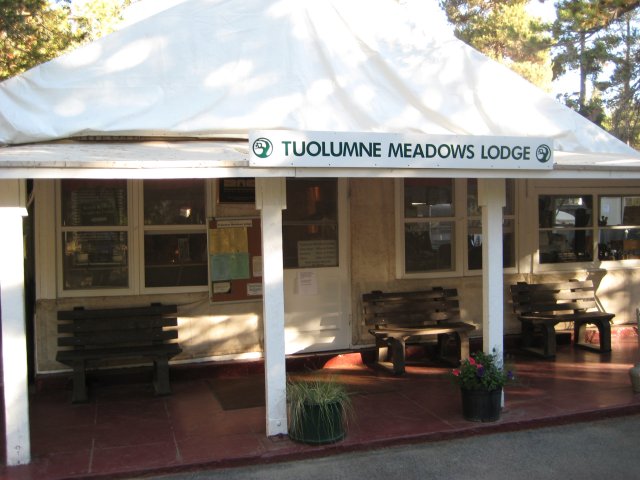
We checked out of Motel 6 at Mammoth and made a very leisurely drive up to Tuolumne Meadows Lodge arriving about 1PM.
Now we started to make
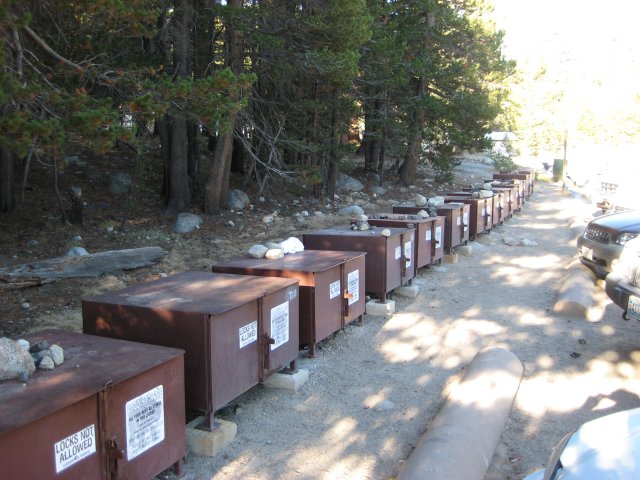
the first adjustments to HSC living---sharing 4 person tent cabins, public showers
and toilets, securing all food and cosmetic stuff in bear proof lockers
 and
excellent meals in the big tent dining rooms. The Tuolumne Meadows tent cabin
was $108 per night for the 4 of us which did not include the meals (dinner
reservations required) that are ordered via menu.
and
excellent meals in the big tent dining rooms. The Tuolumne Meadows tent cabin
was $108 per night for the 4 of us which did not include the meals (dinner
reservations required) that are ordered via menu.


September 3, 2007 Monday
This was the day to start the hikes!! Weather was beautiful for the whole trip and neither too hot nor too cold along the way.
The first duty was to move our cars to approved overnight parking spots and make sure there was nothing in the cars that might attract the attention of bears. All coolers, drink bottles, food, etc went into the bear lockers and we trusted that no one would steal them while we were gone as everyone must share the same lockers.

The Park service provides a very convenient, free bus service along the Tioga Pass road so it is easy to get to and from the parked cars.
At 10AM the four of us started our hikes heading for our first camp. Vogelsang HSC at 10,300 feet elevation is the highest of the 5 camps and I thought it wise to do it first with a one day lay-over. Tuolumne Meadows Lodge is at 8600 feet so we had 1700 feet to gain in 7.2 miles total distance. Carol and Debra went a longer route via the lovely Lyell Fork of the Tuolumne River while JJ and I did a direct route up the Rafferty Creek trail.
We soon crossed the
Lyell Fork
 via permanent footbridges and then headed up the Rafferty Creek
trail. I told JJ we could surely find plenty of water along the way (we had our
trusty water filter pump) as we would be right by the creek all the way.
WRONG!! Due to the continuing drought many of these creeks are bone dry and are
no longer reliable sources of drinking water. Fortunately for us we soon meet
two guys who were on their way out. They told us there was limited water
available but were willing to give us their water. Actually, JJ had to
reluctantly trade her remaining wine supply for water and one of the guys
promptly gulped it down.
via permanent footbridges and then headed up the Rafferty Creek
trail. I told JJ we could surely find plenty of water along the way (we had our
trusty water filter pump) as we would be right by the creek all the way.
WRONG!! Due to the continuing drought many of these creeks are bone dry and are
no longer reliable sources of drinking water. Fortunately for us we soon meet
two guys who were on their way out. They told us there was limited water
available but were willing to give us their water. Actually, JJ had to
reluctantly trade her remaining wine supply for water and one of the guys
promptly gulped it down.
At about 3:30PM our
excellent adventure almost became a bogus journey as JJ began to feel the bad
effects of altitude and exertion with nausea, headaches and exhaustion.  Regardless, we arrived at Vogelsang in time for the standard dinner ritual which
was the same for all the camps. At 6PM the first dinner bell
Regardless, we arrived at Vogelsang in time for the standard dinner ritual which
was the same for all the camps. At 6PM the first dinner bell
 is rung to
announce the serving of hot tea, cocoa and coffee. No alcoholic beverages are
served in the backcountry HSCs. However, if one is willing to lug around a bit
of brandy I can testify that it goes well with the hot drinks.
is rung to
announce the serving of hot tea, cocoa and coffee. No alcoholic beverages are
served in the backcountry HSCs. However, if one is willing to lug around a bit
of brandy I can testify that it goes well with the hot drinks.  At 6:30PM the
final dinner bell is rung to announce that dinner is being served. The guests
require no urging to follow the bells. Meals are served family style which
provides a great opportunity to meet other guests and exchange trail
information.
At 6:30PM the
final dinner bell is rung to announce that dinner is being served. The guests
require no urging to follow the bells. Meals are served family style which
provides a great opportunity to meet other guests and exchange trail
information.

September 4, 2007 Tuesday
The official camp
morning starts at 7AM with the first bell for hot drinks followed by the
breakfast call at 7:30AM . The hearty breakfasts typically include hot cereal,
fruit bowls, sausage and/or bacon, eggs scrambled or omelets and pancakes.
followed by the
breakfast call at 7:30AM . The hearty breakfasts typically include hot cereal,
fruit bowls, sausage and/or bacon, eggs scrambled or omelets and pancakes.
This was a leisure day
for the four of us so we did some explorations of the area. JJ (now revived and
adjusted to altitude) and I strolled around nearby Fletcher and Townsley Lakes
 in a strong wind which had started during the night. The wind seemed to bring a
slightly cooling trend.
in a strong wind which had started during the night. The wind seemed to bring a
slightly cooling trend.
In the late afternoon I spotted four ladies from San Diego WalkAbouts who had just arrived at Vogelsang as they completed their “lottery “ loop going in the counter-clockwise directions-opposite to us. It was fun to hear of their experiences along the path that we would soon traverse. During the evening hot drink period we also made the acquaintances of 5 ladies who were on the same clockwise loop and the 9 of us would have lots of opportunity to visit for the next week.
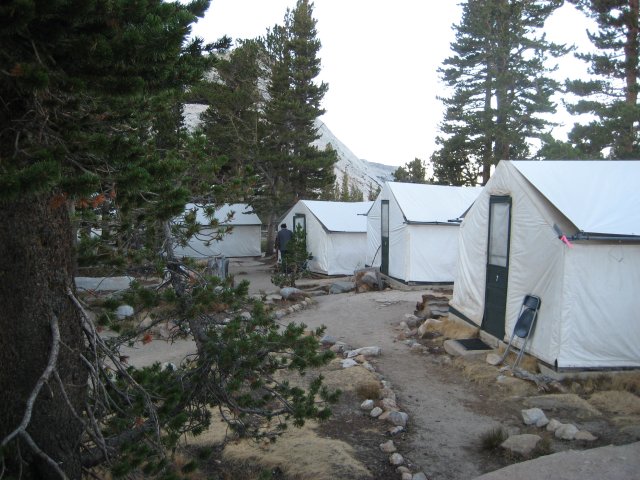
There are 12 tents at
Vogelsang which accomodate up to 48 people. Most of the camps were full during
our visits.

September 5, 2007 Wednesday
We departed Vogelsang at
9:30AM for the mostly downhill hike to Merced Lake HSC at 7150 feet elevation
and 7.6 miles distance. Carol and Debra took a longer route via Vogelsang Pass
while JJ and I did the western direct route along Fletcher Creek. I was
pleased to notice that the Park service still uses the metal trail signs that I
recalled from many years ago. Perhaps, they are the very same signs?
 The trails are heavily used and all intersections
are well marked so direction finding is not much of a challenge.
Regardless, I enjoyed using my GPS-grid TOPO! maps which are based upon the
older USGS survey from years past. The good news is that the mountains and
valleys have not moved and, indeed, the trails are in the exact same locations
as indicated on the maps.
The trails are heavily used and all intersections
are well marked so direction finding is not much of a challenge.
Regardless, I enjoyed using my GPS-grid TOPO! maps which are based upon the
older USGS survey from years past. The good news is that the mountains and
valleys have not moved and, indeed, the trails are in the exact same locations
as indicated on the maps.
As we were passing through a large meadow we spotted a woman talking on her satellite phone! At first I thought she was re-arranging her appointment schedule. Later she apologized for her transgressions and explained that as she was traveling alone her family demanded that she check in regularly so they would know she was OK.
At about 2:45PM my brand new Canon SD1000 digital camera died!! This was a major upset but fortunately for me Carol saved the day by loaning me her backup film camera for the rest of the trip. I had the film digitized at COSTCO for only $3 per roll for this web site. Canon will replace the digital camera under warranty!
Along the way we spotted
a fire burning
 well above the trails. I learned later that this same fire has
been smoldering since a lightning strike in early July! The Park allows
lightning fires
well above the trails. I learned later that this same fire has
been smoldering since a lightning strike in early July! The Park allows
lightning fires
 to burn naturally although they keep a close watch to be sure
they don’t get out of control. We passed through many burnt areas along the
trip as well as large stands of trees that seem to have been killed by bark
beetle infestations. Dry and warm conditions aggravate both the fires and
beetle problems. I suppose this could be an effect of climate change. I stopped
most of my backpacking about 20 years ago due to lower back pains but I do not
recall having seen so many dead trees in the old days (could just be a selective
memory). I wonder if there will still be any Sierra forests when our grandsons
are old men?
to burn naturally although they keep a close watch to be sure
they don’t get out of control. We passed through many burnt areas along the
trip as well as large stands of trees that seem to have been killed by bark
beetle infestations. Dry and warm conditions aggravate both the fires and
beetle problems. I suppose this could be an effect of climate change. I stopped
most of my backpacking about 20 years ago due to lower back pains but I do not
recall having seen so many dead trees in the old days (could just be a selective
memory). I wonder if there will still be any Sierra forests when our grandsons
are old men?


At 4:40PM we arrived at Merced Lake HSC for another two night’s stay.


September 6, 2007 Thursday
We had a good dinner last night with halibut and then some informal entertainment around the camp fire provided by a lady who played guitar and sang a bit like Joan Baez.
Merced Lake is the
largest of the backcountry HSCs with 22 tents for 88 people, hot showers,
flushing toilets and a laundry room (sort of)
 and even a clothes line.
Speaking of toilets- three camps have flushing toilets (Merced, May Lake and Glen Aulin) while the other two have waterless, composting toilets. With the latter instead of flushing you throw in a cup of sawdust! Only Merced and May Lakes had operating showers for this dry season.
JJ and I took a stroll
along the shore of Merced Lake
 and down the Merced River a short way. This is
the same Merced River that produces the spectacular Vernal and Nevada Falls that
so delight visitors to Yosemite Valley (at least those visitors willing to walk
a few miles to the Falls)
and down the Merced River a short way. This is
the same Merced River that produces the spectacular Vernal and Nevada Falls that
so delight visitors to Yosemite Valley (at least those visitors willing to walk
a few miles to the Falls)
 At these lower elevations on the western side of the Sierras there is a relative
abundance of vegetation included ferns
At these lower elevations on the western side of the Sierras there is a relative
abundance of vegetation included ferns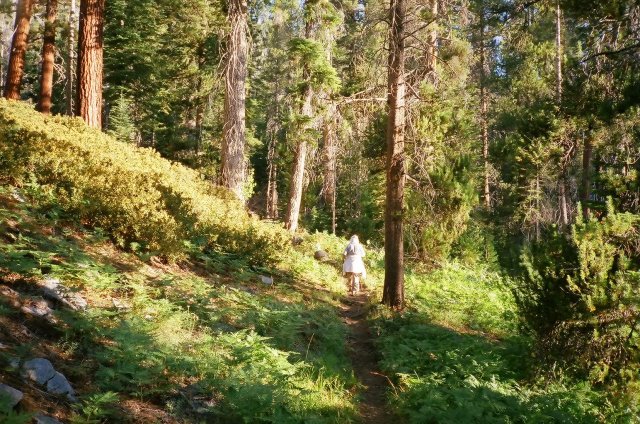 and the world's largest White Fir tree
 (at least that is what the sign said.)
That evening we had a campfire lecture by Ranger Ryan who was leading a guided tour around the loop. The Rangers are held in high esteem by both visitors and the camps’ Delaware North Company employees.
September 7, 2007 Friday
We departed the camp at 6:35AM missing our last breakfast at Merced Lake. We had hired one of the young employees to carry JJ’s pack up to Sunrise HSC for $150. They are happy to provide this service in order to make a few extra dollars and they can make the trip in about 3 hours. The Sunrise HSC is at 9400 feet elevation with a gain of 2290 feet in the 10 miles from Merced.
The High Sierra Camps costs about $150 per day per person including lodging and two meals (breakfast and dinner). For an additional $12 you can buy a bag lunch with sandwich, fruit, cookies and peanuts. We usually just bought a peanut butter and jelly sandwich for $2.50. Credit cards and checks are OK. The lunches are ready for pick-up after breakfast or earlier if you skip breakfast.
 The prices are quite reasonable considering all
the effort required to run the camps. All supplies are brought in to each
camp by mule train every few days.
The prices are quite reasonable considering all
the effort required to run the camps. All supplies are brought in to each
camp by mule train every few days. 

Feeling a bit
adventurous we decided to take a “short cut” to Sunrise by doing a cross
country, off trail hike using the “Jayne Mansfield” route which is easily
distinguishable from the main trail as it passes between two enormous, rounded
granite domes near the highest point to the northwest of the main trail. (I
wondered how many of the younger hikers would understand the meaning of the name
“Jayne Mansfield”)

Anyway, this approach worked well and we reached the camp at 2PM immediately following the young girl who carried JJ’s pack from Merced Lake also using the Jayne Mansfield route.
At Sunrise our group of 4 was split up since the camp manager had an odd numbered assortment of people. I was put in a two man tent with a solo hiker, Jim, while the 3 girls went to an all female 6 person tent. The other three ladies never showed up, however.
Speaking of male/female ratios-I made the curious observation that most of the High Sierra Campers are female! In fact, my scientific counts during dinners revealed that about 70% of the campers were adult women and some were hiking solo! We concluded that the men were backpacking and I sort of confirmed this theory by counting backpackers on our last day. However, the backpackers were mostly young men so I still can’t account for the lack of “adult” (senior?) men at the camps. Was this an anomaly or are the older guys too wimpy?
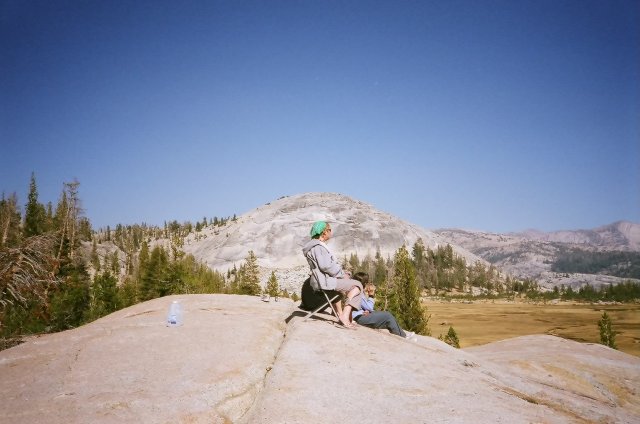
Sunrise is the newest of
the HSC having been built in 1961 and, as the name implies, is noted for the
spectacular sunrises and sunsets that can be seen from the adjoining granite
“viewing” ledges.
September 8, 2007 Saturday
We departed Sunrise at 9:05AM for our next destination, May Lake at 9270 feet and 8 miles distance. This leg of the loop was unique in that we first made a descent of 1250 feet to Tenaya Lake and then a climb back up of 1120 feet to May Lake. This leg also crosses the Tioga Pass highway which offers some temptations to return to civilization and retrieve the cars.
Before making the steep
descent we had a great viewing point looking into the Yosemite Valley. In fact,
we were right at the head end of the Valley into which the Tenaya Creek flows
(in wet years) from the lake. The famous Half Dome and Cloud’s Rest peaks were
readily visible.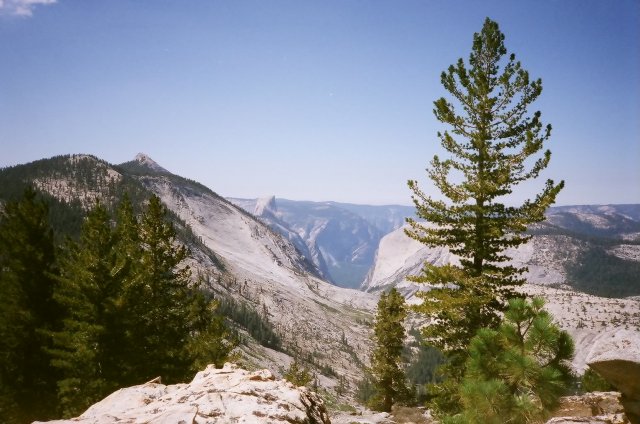

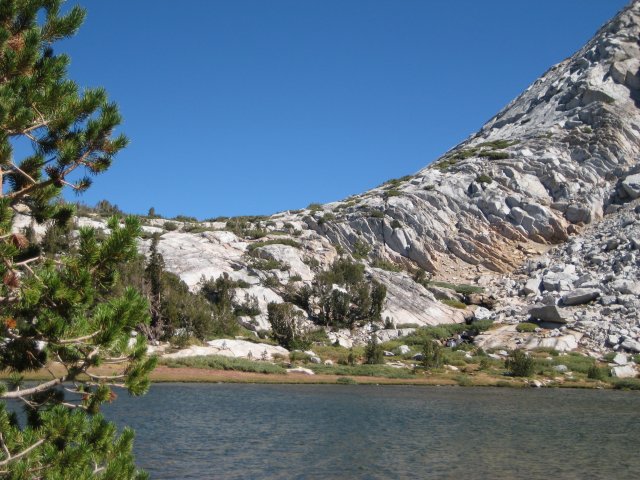
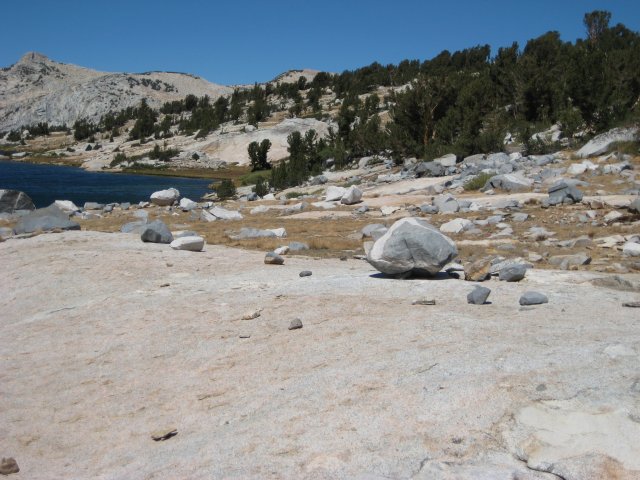
Along this trail and,
indeed, any of the trails it is a humbling experience to realize that where we
walked was once under thousands of feet of glacial ice during the last ice ages.
Sometimes it seemed the glaciers had just left yesterday (rather than 20,000
years ago) for their signatures were much in evidence. The U-shaped valleys,
polished and striated granite rocks, smooth, rounded granite domes and glacial
erratics (randomly distributed boulders) were just as they had been left by the
melting ice and offer ample evidence of the awesome forces exerted by the moving
ice.



We reached the Tioga Road at 2PM and decided to fetch the car and drive up to a parking lot only 1.2 miles from May Lake. This worked well and we reached May Lake at 5:10PM in plenty of time for the dinner rituals.
May Lake is a very
popular spot as it is easily accessible from that aforementioned parking lot.
It also has a laundry facility and a single shower each for men and women.


We learned that evening it is wise to avoid May Lake on Saturday nights as it seems to attract the “party” crowd due to easy access. I also heard a crying noise at night which I thought was an animal only to learn the next day it was a 3 month old baby boy not enjoying his first wilderness experience with mom and dad.
At steak dinner we had a good lecture by the camp manager, Brian. He told us a bit of the history of Yosemite National Park. I had recently been to Yellowstone Park and I was impressed by the similar histories. The first white man to visit was Joseph Walker in about 1830. The first park tourist was in 1855. No autos were allowed until about 1913 while today they get about 4 million cars per year! When the National Park Service was established in 1916 the Rangers began to replace the U. S. Army cavalry who had been in charge. Prior to the automobiles all tourist came via stage coach and as only wealthy people could afford the vacations these stage coaches were frequently robbed.
At all the camps the staff people always introduce themselves to the guests after dinner. Most of the employees are young folks who are enjoying a cool summer job but others, including Brian, have many years experience doing park work.
September 9, 2007 Sunday
We were treated to a
spectacular sunrise and reflections in May Lake were mirror perfect!


At 9:45AM JJ and I departed for our final camp, Glen Aulin, which apparently means beautiful valley in Gaelic.
This was a relatively
easy 8.1 mile hike and was almost all downhill or flat. Arriving at 4:20PM we
were treated to a view of a typical Tuolumne River waterfall right in front of
the camp.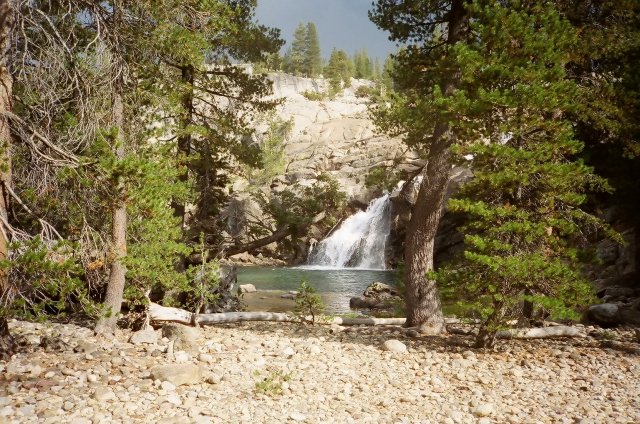 The Tuolumne, a major source of water for San Francisco, enters the Hetch Hetchy Reservoir quite a few miles downstream from Glen Aulin.


Glen Aulin is the smallest of the HSC with only 8 four person tents and, because of the Tuolumne public water supply, is restricted on the amount of water that can enter the septic system. For example, while May Lake consumes about 1600 gallons per day Glen Aulin uses only about 400 gallons.


This evening we enjoyed a modest thunder storm and a tiny bit of rain. This was just a typical Sierra afternoon cumulus build up.
September 10, 2007 Monday
Well, this is the last day of our High Sierra experience. We said farewell to Carol and Debra who were off for their next adventure in Zion National Park.

We departed at 9:10AM following the Tuolumne River upstream back towards Tuolumne Meadows. During our lunch break by the river we spotted an Osprey (I think) sitting in a dead tree and eating a fish. I did not know Osprey are native to this area.
Speaking
of wild critters: We saw many hawks, many does with their young fawns, a family
of Sierra grouse (I think), ducks, purple martin? (Carol and Debra spotted this
one) and, of course, marmots, squirrels, chipmunks, etc.
In Yosemite Valley we saw a merry band of three buck deer with very impressive antlers. Apparently, they have done their duties and are leaving the fawn raising up to the females. What we did NOT see were any bears! Apparently the decades of bear locker use and requirements that backpackers use bear-proof cannisters have paid off. My recollections are that years ago backcountry users would always encounter bears if you were close to a Park.
We arrived back at the
parking lot and bus stop at 2PM. Then we took the bus back to the Sunrise/May
Lake trailheads. While JJ waited I walked back up the 1.5 miles along May Lake
trail to recover the car. Hence, I did finally hike every segment of the loop.
Naturally, I forgot to get our stuff from the bear lockers at the May Lake/Snow
Flat parking lot so we got to drive back up there again. This narrow road is
apparently a remnant of the original Tioga Pass road which was rebuilt in 1961.
(I did a college tour of the west in 1962 so I must have used the brand new
Tioga Road)
So this completed our 47.5 mile High Sierra Camp adventures. JJ and I went down to Yosemite Village to stay at a cabin in Curry Village ($109) with shared bath and showers (lots of water!)
It was quite hot down in the Valley so we decided to head back to San Diego on Sept 11 concluding that our earlier plans to hike both Half Dome and Mt Whitney were a bit overly optimistic.
Back in 1975 I did a trans-Sierra backpacking trip with a couple of China Lake pals. We went from Mammoth Lakes area to Yosemite Valley. Along the way I saw for the first time two of the High Sierra Camps-Vogelsang and Merced Lake. At that time I decided that one day I would return and stay at those camps. Well, it took 32 years to fulfill that dream but it was well worth the wait. I don’t intend to wait another 32 year for my next visit!!